ServiceNow

Are you considering ServiceNow CRM Sales and Order management and CPQ?
ServiceNow CRM Sales and Order management and CPQ have some powerful functionalities that can help streamline the Lead-to-Cash processes, especially for Technology Providers and Telecommunication companies. Therefore we see many companies that are evaluating and considering ServiceNow CRM.
Many companies already have ServiceNow Customer Service Management (CSM) handling post-sales support, ServiceNow ITSM for IT operations and a classical CRM solution like Salesforce or Microsoft Dynamics handling the front-end sales hustle.
Now, you want to bridge the gap using ServiceNow Sales and Order Management (SOM) and CPQ.
The million-dollar question is: In what order do you roll these out? Do you fix the quoting process first? Do you tackle order fulfillment? Or do you try to rip and replace the CRM immediately?
Getting this sequence wrong results in "shelf-ware" and frustrated sales teams. Getting it right creates a seamless flow from "Opportunity" to "Renewal."
This article describes a popular approach that I call “The Middle Out” Approach. Later blogs will explore alternative strategies.
To be able to optimize your Lead-to-Cash workflows, you must harmonize your product data.
We often experience that in a split environment, with an external CRM and ServiceNow for support and operations, the definition of a "product" often differs. Sales cares about price and bundling and operations and fulfillment cares about provisioning and assets.
I have seen many CRM implementations where opportunities only have a simple line item like “Support” and an estimated price. Operations needs to know what exactly has been agreed and link it to SLA definitions, sold products and infrastructure components, so they have to dig into the contract documents to find the data they need and manually enter this in ServiceNow. This means there is no direct link from the CRM to ServiceNow and a lot of manual work.
Pro Tip: If your product data is messy, no amount of integration or automation will fix your process. Fix the data first.
Many organizations are tempted to start with CPQ Quote because it’s "sexy" and visible to Sales. This is a mistake. If you implement CPQ without a robust fulfillment engine behind it, you are just letting sales reps quote deals faster, but don’t have a fulfillment engine.
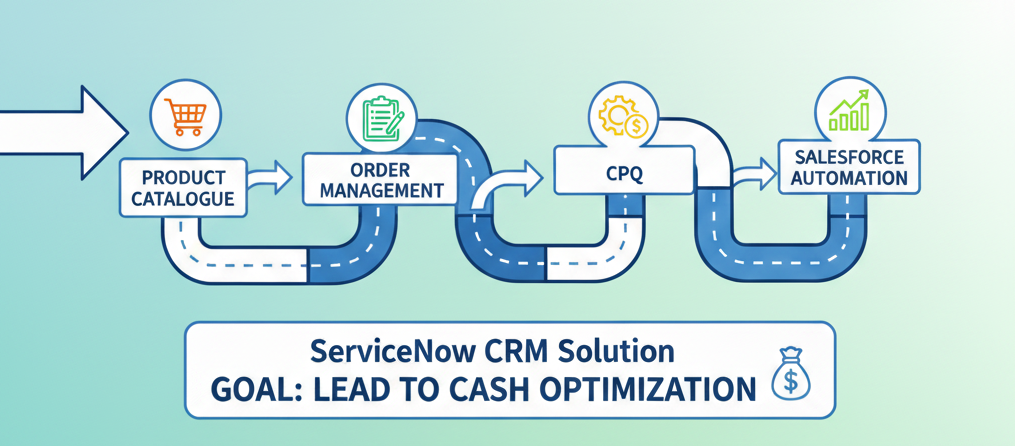
We recommend to implement the Order Management module of SOM first:
As described above we often experience that this step is done manually. By implementing ServiceNow Order Management you optimize your Lead-to-Cash process, which eliminates a lot of manual efforts and errors.
The Value: This immediately benefits your operations team. Support agents can finally see exactly what was sold and its current deployment status without swiveling chairs.
Once your fulfillment engine (Phase 2) is running, you can move upstream to CPQ.
Now that ServiceNow knows how to fulfill an order, it is perfectly positioned to tell Sales how to configure it.
The final piece of the puzzle is moving the actual Opportunity and Lead management into ServiceNow Sales Force Automation.
With this implementation strategy we work from the Middle-Out.
|
Sequence |
Module |
Purpose |
Stakeholder Benefit |
|---|---|---|---|
|
1 |
Product Catalog |
The "Brain" |
Data consistency across the enterprise. |
|
2 |
Order Management |
The "Backbone" |
Ops & CSM get visibility; Support knows what the customer owns. |
|
3 |
CPQ |
The "Mouth" |
Sales quotes complex bundles accurately based on fulfillment rules. |
|
4 |
SFA (CRM) |
The "Face" |
(Optional) Full platform consolidation. |
By prioritizing Order Management, you leverage your existing CSM investment immediately, turning your support team into proactive partners who know the customer's context the moment they pick up the phone.